Fear Grips Caracas After US Strike Claims and Maduro Capture
Fear and Confusion Grip Caracas as U.S. Strikes and Maduro Capture Claims Shake Venezuela
Caracas, Venezuela
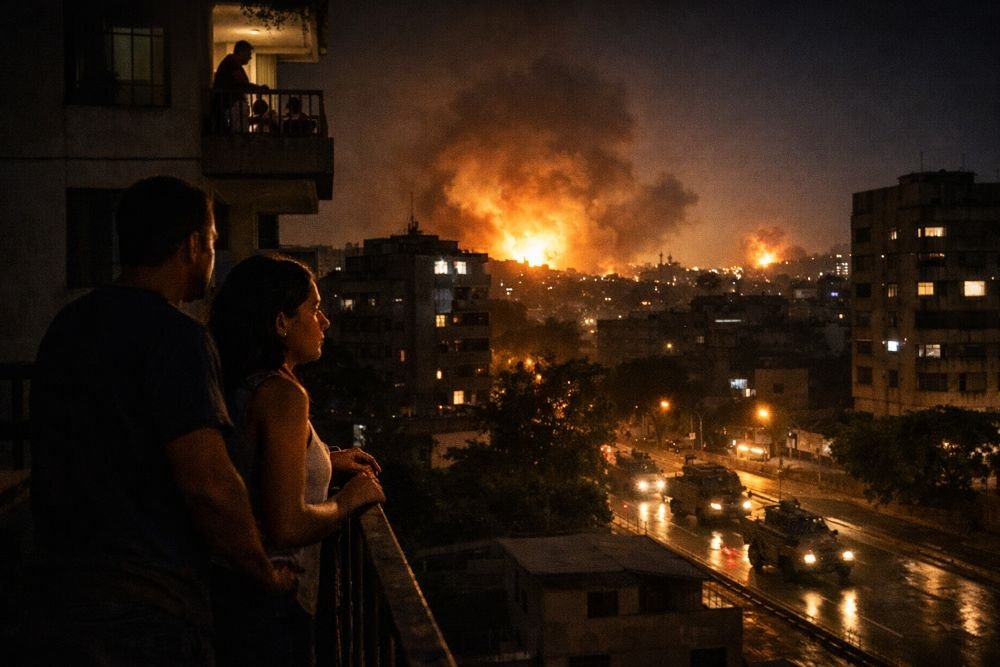
Caracas woke up in fear and disbelief early Saturday after explosions echoed across the capital and conflicting claims emerged about a dramatic U.S. military operation targeting Venezuela’s leadership.
Power outages, troop movements, and widespread rumors spread faster than verified information, leaving ordinary residents unsure of what was real and what was propaganda.
U.S. President Donald Trump claimed on social media that American forces had carried out a “large-scale strike” in Venezuela and captured President Nicolás Maduro, triggering global shock and immediate denials from Venezuelan officials.
Explosions, blackouts, and unanswered questions
Residents in Caracas reported loud explosions in multiple districts before dawn, followed by electricity failures in parts of the city and surrounding states. Social media filled with videos of flashing skies, military convoys, and helicopters circling near strategic locations, including areas close to Fuerte Tiuna, Venezuela’s largest military base.
“I heard the blast before the lights went out,” said a resident in the southern part of the city, who asked not to be named out of fear. “No one knows what is happening. People are afraid to leave their homes.”
Maduro government denies capture, declares aggression
Venezuela’s government quickly rejected U.S. claims, calling the strikes an act of “military aggression” and insisting that President Maduro had not been captured. Defense Minister Vladimir Padrino López announced the deployment of armed forces nationwide, urging calm while accusing Washington of violating Venezuela’s sovereignty.
State television showed images of senior officials meeting behind closed doors, while emergency measures were announced in several regions. Schools and offices in parts of the capital remained closed as uncertainty continued.
U.S. silence fuels panic and speculation
While President Trump amplified the claim of Maduro’s capture, U.S. defense officials stopped short of confirming details publicly. Reuters reported that explosions and military activity were confirmed by multiple witnesses, but independent verification of Maduro’s status remained unavailable hours after the initial claims.
The lack of clear, unified communication from Washington added to the chaos, both inside Venezuela and abroad, where markets, airlines, and governments scrambled to assess the risk of a broader conflict.
Allies react as region braces for fallout
International reaction was swift. Russia, Cuba, and Iran condemned the reported U.S. action, warning it could destabilize the region and violate international law. Neighboring countries, including Colombia, increased border monitoring amid fears of refugee movements or spillover violence.
The U.S. Federal Aviation Administration temporarily restricted flights over Venezuelan airspace, signaling concerns about aviation safety as military operations continued.
A city caught between rumor and reality
For people on the ground, the political arguments mean little compared to the immediate fear. Grocery stores in some neighborhoods closed early. Fuel lines reappeared. Messaging apps buzzed with unverified reports of additional strikes, arrests, and troop landings.
“This feels like the start of something bigger,” said a shop owner in central Caracas. “We’ve lived through crises before, but this feels different. No one is telling us the truth.”
What comes next remains unclear
As of Saturday afternoon, no independent confirmation existed that Maduro had been captured, despite repeated claims from Trump. Venezuela’s leadership remained publicly defiant, while U.S. officials offered limited comment beyond statements framing the operation as necessary for regional security.
For now, Venezuela stands frozen between fear and uncertainty, its capital bracing for what may come next as the world watches for clarity in a situation defined more by shock than answers.