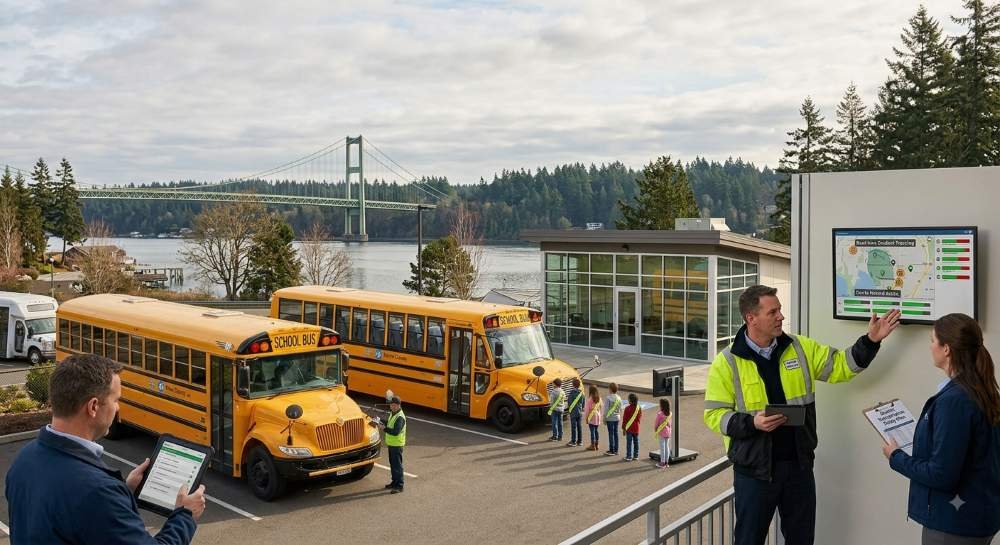
What Tacoma, Kitsap and Pierce County Schools Should Know About Safe School Transportation
When schools vet a transportation provider, the checklist usually starts and ends with licensing, insurance, background checks, and vehicle inspections. Those requirements matter, but they say little about what actually happens once a student is in the vehicle and on the road. That gap becomes especially important for students who don’t ride a traditional school bus, students with disabilities, medical conditions, mobility limitations, behavioral needs, or specialized schedules, who often travel alone with a single contracted driver.
Beyond Ride has laid out the driver monitoring framework behind its school transportation services across Tacoma, Kitsap County, and Pierce County, aiming to give administrators a clearer picture of oversight that continues well past the hiring stage.
The system pairs live GPS tracking with driver performance analysis, vehicle event monitoring, and documented trip records, covering every ride from pickup to drop-off. GPS data gives authorized personnel real-time visibility into vehicle location, route progress, and arrival times, while also creating a record schools can reference if questions come up about a delay or route change.
On the driving side, Verizon Connect flags events like speeding, harsh braking, rapid acceleration, excessive idling, and unexpected stops. Rather than treating every flagged event as a problem, Beyond Ride’s transportation managers review the context, distinguishing between careless driving and a reasonable response to traffic, pedestrians, or road hazards.
The company extends that review beyond vehicle data alone. Driver behavior, speech patterns, facial expression, and voice modulation are also analyzed, giving management a way to catch patterns that might call for coaching, separate from what a background check could ever surface. Interior and exterior video and audio recording round out the picture, creating documentation schools and families can request if a question arises about a specific trip.
Communication is built into daily operations too. When a delay or unexpected issue comes up, Beyond Ride says dispatch reaches out directly to school staff and authorized family contacts rather than relying only on automated alerts.
The monitoring framework supports Beyond Ride’s work with students who need extra assistance, including special education transportation and transportation for children with disabilities, using wheelchair-accessible vehicles and drivers trained to support passengers with mobility needs. That experience carries over into the company’s non-emergency medical transportation services across Tacoma, Pierce County, and Kitsap County, where similar attention to mobility limitations applies.
Routes across the region vary widely, from congested school-zone traffic and construction in urban Tacoma to longer stretches and limited access roads in more rural parts of Pierce and Kitsap counties. Beyond Ride argues that continuous monitoring doesn’t remove those challenges, but it does give transportation managers more to work with when evaluating how drivers handle them day to day.
For schools comparing providers, the company suggests the real differentiators are less about whether monitoring technology exists and more about how quickly flagged events get reviewed, how records are maintained, and how communication holds up when something goes wrong.