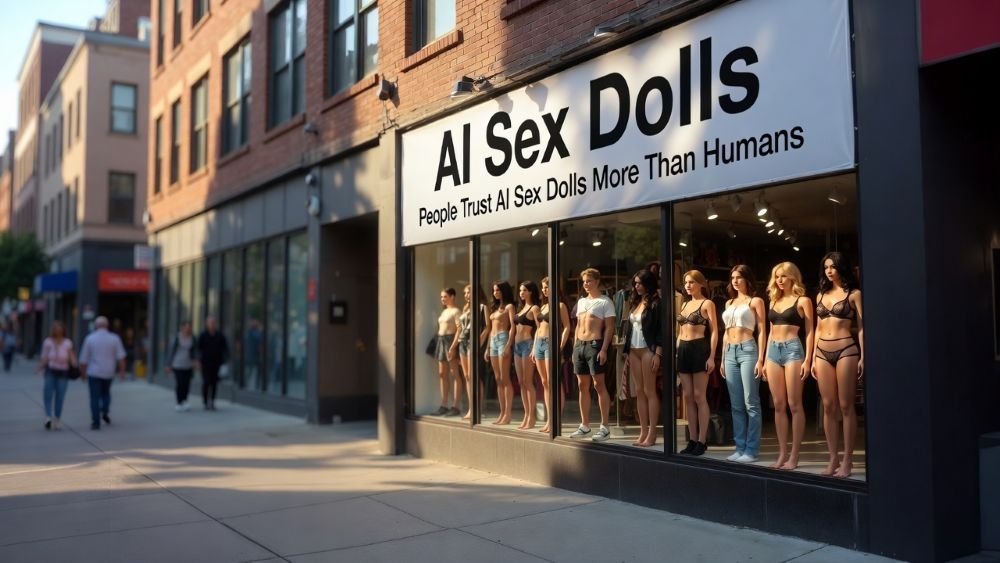
People Trust AI Sex Dolls More Than Humans
People are beginning to trust AI sex dolls more than humans not because they think machines are “better,” but because machines feel safer. No judgment. No rejection. No emotional backlash. No gossip. No consequences. And that single psychological advantage is now becoming one of the biggest hidden reasons the AI intimacy industry is accelerating.
This shift is not just sexual. It’s emotional. It’s mental. It’s about vulnerability. And research shows the pattern is real: people often disclose intimate information to AI at rates comparable to humans, sometimes because AI reduces fear of being judged. As per the journal International Journal of Human-Computer Studies, people were just as likely to self-disclose to an AI as to a human researcher, and trust was linked to disclosure.
The main reason: people feel “emotionally safe” with AI
Let’s get brutally honest about modern relationships.
Humans come with:
- judgment
- embarrassment
- rejection
- emotional punishment
- shame
- reputation risk
AI doesn’t.
For many users, AI sex dolls create a space where they can be fully themselves without fear of being laughed at, rejected, or exposed. That emotional safety can feel intoxicating, especially for people who have dealt with humiliation, loneliness, social anxiety, or repeated relationship failure.
And this isn’t just theory.
Research into disclosure and chatbots has found that people can be willing to share intimate information with AI, and that it can create feelings of relief. As per Oxford Academic (Interacting with Computers), researchers investigated willingness to disclose intimate information to a chatbot versus a human, and how this could enhance emotional well-being through relief.
In short: people trust what won’t judge them.
The “no rejection” effect is the trust engine
With AI dolls, there is no fear of being turned down, no feeling of being “too much,” no anxiety about performance, no awkward social negotiation.
That changes everything.
In human intimacy, fear of rejection often controls behavior. It shapes how people communicate, what they hide, and what they never admit out loud. AI wipes out that fear, and that becomes a trust accelerator.
So when the headline says “people trust AI sex dolls more than humans,” what it really means is this:
People trust systems that feel emotionally non-threatening.
This has a name and it’s been happening for decades
This isn’t new behavior. It’s just getting stronger.
Back in the 1960s, one of the earliest chatbots, ELIZA, shocked its own creator because people started treating it like a real listener, even when it was extremely simple. That human tendency to project understanding and care onto machines is known as the ELIZA Effect. As per the Weizenbaum Institute’s ELIZA exhibition, this effect describes the belief that computers have human-like qualities because they communicate like humans.
Now imagine ELIZA in 2026 with:
- voice
- memory
- personality
- emotional scripts
- and a physical body
That trust response becomes even stronger.
The positive benefits: why some people genuinely improve
Here’s where this story flips from controversy to something more human.
For some people, AI intimacy tools can:
- reduce loneliness
- lower shame and anxiety
- provide confidence-building practice
- create emotional stability during isolation
- offer companionship without manipulation
And studies about robots in social contexts show that people respond emotionally to robot interactions, including comforting behaviors. As per a 2024 paper in Frontiers in Robotics and AI (available on PubMed Central), participants evaluated emotional vulnerability and comforting gestures in human-human vs human-robot scenarios, showing how robots can operate inside emotional expectations people already have.
This matters because for many users, trust is not about “believing the machine loves them.”
It’s about this:
The machine won’t hurt them.
Trust isn’t always logical but it is predictable
Even when people know an AI is artificial, trust can still form because of consistency.
Humans can be unpredictable.
Humans can lie.
Humans can shame.
Humans can betray.
AI feels predictable. Controlled. Stable.
And trust research supports that humans can behave similarly in trust-based situations with robots and humans. As per a study in Journal of Economic Behavior & Organization, participants invested similarly in trust games involving humans vs robots, though emotional reactions differed.
So yes, even trust in “serious” contexts can translate to machines.
The deeper truth: trust is moving from morals to mechanics
In the past, people trusted a partner because of values.
Now many people trust machines because of features:
- privacy
- control
- predictability
- non-judgment
- personalization
That’s the scary part for some people.
But it’s also why this industry is growing.
AI sex dolls aren’t winning because they’re “better than humans.”
They’re winning because they feel safer than humans.
Bottom line
People trust AI sex dolls more than humans for one reason that nobody wants to say out loud:
Humans can hurt you. AI can’t in the same way.
And as AI becomes more emotionally responsive, more personalized, and more human-like, this trust shift won’t slow down. It’ll spread.
Curious how AI sex dolls might actually curb cheating instead of fueling it? The real story is wild and controversial. Find out more here: https://iamericantimes.com/can-ai-sex-dolls-reduce-cheating/