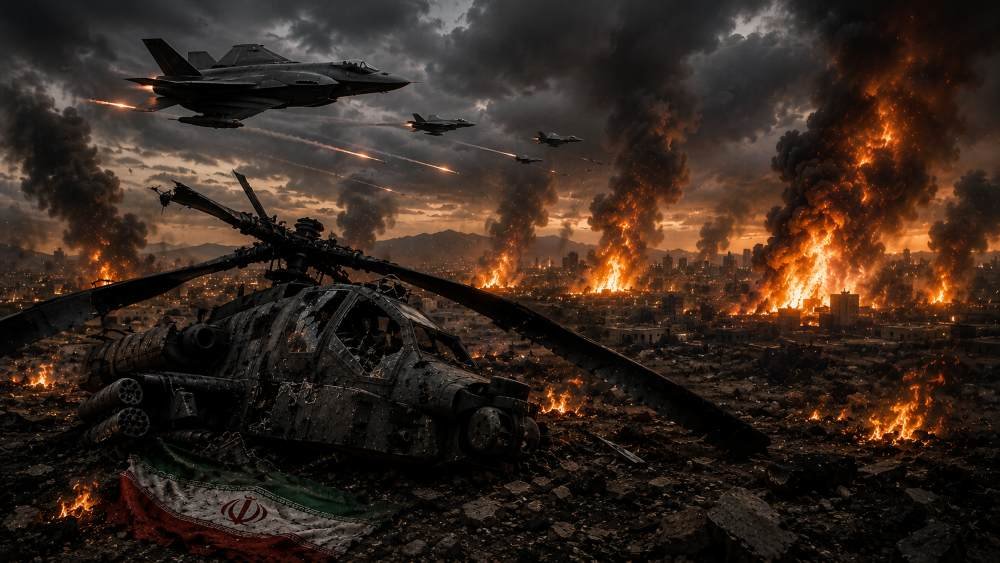
Ceasefire Is Crumbling: U.S. Launches Massive New Strikes on Iran After Apache Helicopter Shot Down – What It Means for You
The fragile ceasefire between the United States and Iran is unraveling tonight, and every American is about to feel the consequences.
U.S. forces launched a sweeping new wave of strikes against Iranian military targets Wednesday, just hours after President Trump vowed retaliation for Iran’s downing of an American Army Apache helicopter near the Strait of Hormuz. The escalation marks one of the most serious breakdowns in the conflict since fighting began on February 28, and it is already rattling stock markets, pushing oil prices higher, and threatening to send inflation to levels not seen in years.
Here is everything you need to know.
What Happened Overnight
U.S. Central Command forces began launching self-defense strikes against Iran at 5 p.m. ET Tuesday at the Commander in Chief’s direction, in response to the downing of a U.S. Army Apache helicopter. CNBC
The U.S. military had earlier revealed that the AH-64 Apache helicopter went down on Monday evening near the coast of Oman while patrolling regional waters. Two crew members were rescued by American forces using a Navy drone vessel within two hours, and they are in stable condition. CNBC
Trump did not hold back his response. “The two pilots involved in the attack are safe and uninjured,” Trump wrote on Truth Social. “Nevertheless, the United States must, of necessity, respond to this attack.” CNBC
U.S. Marine Corps, Air Force, and Navy assets then fired precision munitions on Iranian targets that CENTCOM said posed a threat to U.S. forces and international commercial ships transiting regional waters. CENTCOM described the strikes as a proportional and defensive response to what it called Iran’s “unwarranted and continued aggression.” Xictron
By Wednesday night, a second wave of strikes was launched. U.S. forces hit multiple targets in Iran after Trump and Defense Secretary Pete Hegseth warned Tehran it would be hit hard. After the latest strikes concluded, CENTCOM denied Iran’s reports that Tehran had closed the Strait of Hormuz and attacked a U.S. warship. Digital Applied Team
Iran Fired Back, 21 Attacks on U.S. Bases
Iran did not absorb the strikes quietly.
Iran claimed it returned fire with 21 attacks against U.S. military targets across the Middle East after the U.S. struck Iranian air defense systems, ground control stations, and surveillance radar sites near the Strait of Hormuz. NPR
Iran’s military vowed more “devastating” strikes in response, casting fresh uncertainty on the negotiations to end the war and reopen the Strait of Hormuz. NBC News
A Qatari diplomatic delegation was in Tehran trying to broker a new agreement when the latest U.S. strikes began, underscoring just how quickly the situation deteriorated from the negotiating table back to the battlefield.
The Ceasefire Is Effectively Dead
To understand how serious this is, you need to understand what was supposed to happen.
On April 8, the United States and Iran agreed to a two-week ceasefire mediated by Pakistan. The deal required Iran to reopen the Strait of Hormuz to commercial shipping and for both sides to pause military strikes. CBS News
That deal never fully held. Neither side removed their blockades. Iran attempted to charge tolls for vessels to use the strait, a move the U.S. Secretary of State called a move that would make any diplomatic deal “unfeasible.” CNN
Transportation through the Strait of Hormuz continued to move at a trickle and remained a major point of contention in all efforts to forge a more lasting peace. Fox News
Now, with U.S. and Iranian forces once again actively exchanging strikes, the path back to peace looks narrower than ever.
What This Means for Your Gas, Groceries, and Wallet
This is not just a foreign policy story. It is a kitchen-table story, and the numbers are alarming.
Inflation is expected to have risen for a third straight month in May. Economists are predicting the Bureau of Labor Statistics’ Consumer Price Index will show the annual rate hit 4.2%, well above the 2.4% level it was before the Iran war began, and the highest point since early 2023. NBC News
High energy prices are to blame. Since the Iran conflict began, oil prices have risen nearly 40%, and consumers are still paying around 40% more on average at the gas pump than they did before the war started. NBC News
Rystad Energy said the shutdown of 11.8 million barrels per day of production across six Gulf producers has created the most severe oil supply disruption in modern history. The consultancy estimates cumulative production losses have reached 1 billion barrels and warned that each additional month of conflict could erase another 350 million barrels of output. NBC News
The pain is spreading far beyond the gas pump. The ripple effects from the Iran war are increasing the risks of acute hunger for millions of people around the world. The prolonged closure of the Strait of Hormuz is sending energy prices, and in turn the cost of food globally, soaring. The World Food Program warned in March that 45 million more people could face acute hunger by July if oil prices remain above $100 a barrel. NPR
Markets Are Rattled
Wall Street is reacting to the renewed escalation.
After U.S. and Iranian forces exchanged strikes overnight, stock futures dropped sharply in early trading. S&P 500 futures were set to fall about 1%, Nasdaq 100 futures tumbled 1.3%, and Dow futures fell 460 points. European markets were also lower, with Germany’s DAX down 0.8% and the U.K.’s FTSE benchmark down 0.6%. NPR
Brent crude rose to $91.10 per barrel Wednesday, up 1.8% on the day. The S&P and Nasdaq are now down 4.5% and 7.1% respectively since hitting record highs just eight days ago on June 2. Hike Web Solutions
Trump’s Message to Americans: “I Love the Inflation”
As frustration among Americans grows, the political fallout is intensifying.
Even some of Trump’s own allies are beginning to push back. Rep. Marjorie Taylor Greene ripped the president’s handling of the economy, saying “MAGA used to call this Biden inflation.” CNBC
Trump, for his part, has remained defiant. The president has continued to assure Americans it is going to work out, saying he just needs a couple more days, but after weeks of hearing the same message, public faith in that promise is growing harder to sustain. Gas prices keep going up and electricity is getting more expensive. PBS
What Happens Next
The road to peace remains treacherous.
Talks between the U.S. and Iran, mediated by Pakistan, have covered issues including freedom of navigation through the Strait of Hormuz, Iran’s nuclear and ballistic missile program, reconstruction, sanctions, and a long-term peace agreement. CNN
Iran has suggested that U.S. payment of reparations is the “only way” to end the conflict, and Iranian officials have estimated $270 billion in direct and indirect damages within Iran, a demand that makes any near-term deal appear extremely unlikely. CNN
For now, the Strait of Hormuz remains a flashpoint. CENTCOM insists the strait is open and that commercial ships continue to transit in and out of the waterway, a direct contradiction of Iran’s claims that it has closed the passage. Xictron
What is not in dispute is this: the U.S. launched new strikes against Iran after accusing it of dragging its feet on negotiations to end the war, and as the conflict continues, prices at home are rising at their fastest rate in three years. Google
Every day this war continues, every American pays the price, at the pump, at the grocery store, and in a stock market that has lost trillions in value since the strikes began in February.