Congress Just Passed the Biggest Housing Bill in Decades – Then Trump Refused to Sign It. Here’s What’s Really Going On.
For one brief moment this week, Washington did something it almost never does: Democrats and Republicans actually agreed on something big.
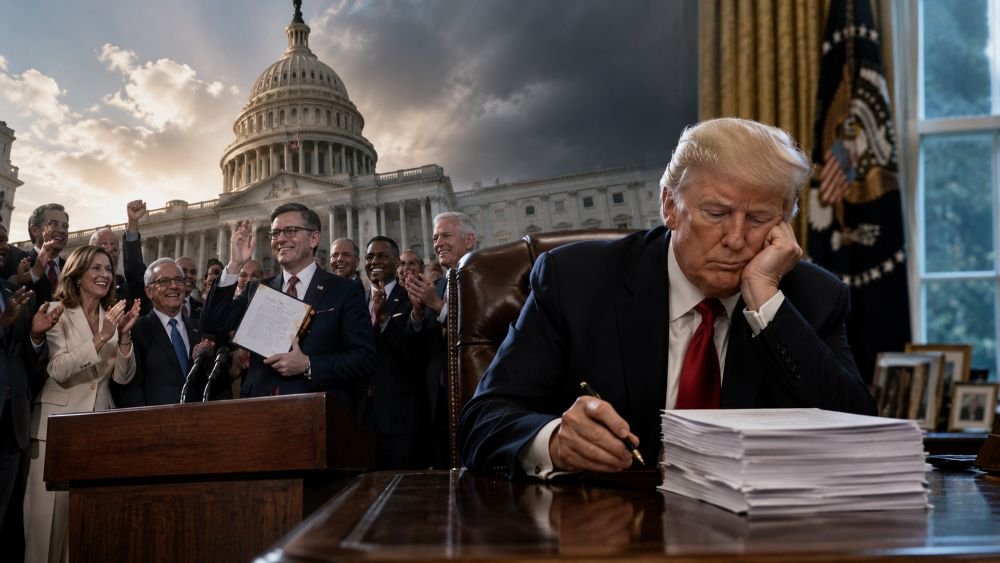
Congress passed the largest housing affordability bill in decades, with stunning bipartisan support in both chambers. It was supposed to be signed into law Wednesday at a Capitol Hill ceremony. Then, less than two hours before the event, President Trump cancelled it, and tied the bill’s fate to a completely unrelated piece of legislation.
Here is everything you need to know about what’s in the bill, why it matters to your wallet, and why it’s now stuck in limbo.
What Congress Actually Passed
The numbers alone tell you how rare this moment was.
As per TIME, the House passed the 21st Century ROAD to Housing Act in a 358-32 vote on Tuesday, after the Senate approved the measure 85-5 the day before. As per ABC News, all 32 no votes in the House came from Republicans, while every Democrat present voted in favor.
As per TIME, Francis Torres, housing and infrastructure director at the Bipartisan Policy Center, called it “a very rare occurrence to have successive bipartisan votes across both chambers on versions of this bill,” adding that it “finally seems to be reaching the finish line.”
As per NPR, Senator Elizabeth Warren put it this way on the Senate floor: it has been more than 30 years since the federal government did anything but watch housing prices climb, and “finally, we are actually moving.”
Why This Bill Exists: A Housing Market in Crisis
As per ABC News, a recent Zillow analysis found the cost of buying a starter home is $1 million or more in a record 242 cities across the country.
As per CNN, homebuilding has lagged in the years since the 2008 financial crisis, creating a housing shortage that has pushed prices higher as demand has outstripped supply across much of the country.
This isn’t a minor problem affecting a few cities. It is the defining affordability crisis of the decade, and with midterm elections coming up, lawmakers from both parties felt the pressure to act.
What’s Actually in the Bill
The legislation is sweeping, as per CBS News, it contains more than 45 separate provisions, but a few changes stand out for how directly they could affect your housing costs.
It targets the housing shortage directly. As per TIME, one of the bill’s biggest goals is increasing the U.S. housing supply, which it pursues by streamlining environmental reviews to speed up home construction. As per CNN, housing experts point to local zoning and red tape as the root of the slowdown in homebuilding, and a 2025 Goldman Sachs report estimated that relaxing land-use regulations could add an extra 2.5 million housing units nationwide over the next decade.
It makes manufactured homes cheaper. As per CNN, manufactured homes have been required by federal law for the last five decades to be built on a permanent wheeled chassis, which increases costs and can limit where these homes are allowed due to zoning restrictions. The new law eliminates that requirement, a change the Bipartisan Policy Center estimates could cut the cost of each manufactured home by $5,000 to $10,000.
It cracks down on big investors buying up homes. As per the Bipartisan Policy Center, the bill restricts the purchase of new single-family homes by large institutional investors that own at least 350 such homes, with exemptions for investors building new homes specifically for the rental market. It also establishes a renter outreach resource to help renters of investor-owned homes navigate landlord disputes.
This provision isn’t symbolic everywhere. As per CBS News, investors own more than 20% of single-family rental homes in Jacksonville, Florida, according to a 2026 Government Accountability Office analysis, and Dallas and Phoenix each added at least 16,000 investor-owned homes between 2018 and 2024, increases of 177% and 114%, respectively.
Will It Actually Lower Your Costs?
Here is the honest answer: not right away, and experts are divided on how much it will help at all.
As per CNN, the bill may not offer immediate relief for Americans shopping for a home this year, and housing advocates acknowledge that while it’s a bipartisan victory, it doesn’t go far enough to fix a housing market that has become the most unaffordable in a generation.
Still, supporters argue the long-term direction matters. As per CNN, Senator Warren said that if implemented efficiently, Americans should over time notice more housing available, in both urban and rural areas, for renters and buyers alike.
The investor restriction, meanwhile, is more controversial among experts than you might expect. As per TIME, Francis Torres of the Bipartisan Policy Center says large investors make up only “a small sliver” of the housing market nationally, arguing the real driver of housing costs is simply an undersupply of homes in places people want to live. As per NPR, these investors make up only about 3% of the single-family rental market nationwide, and some experts warn the ban could actually reduce housing supply, since investors often buy and renovate properties that would otherwise sit vacant. Ross Marchand, executive director of the Taxpayers Protection Alliance, told NPR: “It chills investment, and we need more investment in housing stock, not less.”
Then Trump Cancelled the Signing, Here’s Why
Just as the bill seemed headed for the finish line, things took an unexpected turn.
As per CNN, less than two hours before the planned signing, Trump posted on social media that the housing signing event was “hereby cancelled until such time as we pass the desperately needed SAVE AMERICA ACT,” which he called a “National Emergency.”
As per CBS News, the SAVE America Act is a separate bill that would impose strict new limits on voter registration and ballot casting. Trump and his allies have demanded the Senate take it up, but Republican leaders in the upper chamber say they don’t have the votes to pass it or to change Senate rules to force it through.
Trump’s framing of the housing bill’s importance has shifted noticeably. As per CBS News, he previously downplayed the bill in a social media post, calling it the “Elizabeth ‘Pocahontas’ Warren centric housing bill” and saying it “pales in comparison to passing THE SAVE AMERICA ACT.”
That stance has frustrated members of his own party. As per CBS News, Republican Rep. Don Bacon of Nebraska said: “He’s fixated on the SAVE Act that we passed three times out of the House. He strongly endorsed the housing bill a month ago, so the criticisms now are strange. We made the Senate bill better than when he endorsed it.”
What Happens to the Bill Now
Here is the part that matters most: this bill is not dead, no matter what the headlines about a “cancelled signing” might suggest.
As per CBS News, under the Constitution, a bill that has passed both chambers of Congress and been presented to the president automatically becomes law after a set period, even without his signature, unless he formally vetoes it.
So while Trump can delay the political theater of a signing ceremony, he cannot indefinitely block the bill from taking effect simply by refusing to sign it. The practical question now is how long that delay drags on, and whether it becomes entangled in a broader standoff with Congress over the SAVE America Act.
Not Everyone in the GOP Was On Board
The bipartisan unity, while real, was not unanimous.
As per TIME, all five senators who voted against the bill were Republicans: Ron Johnson of Wisconsin, Mike Lee of Utah, Rand Paul of Kentucky, Rick Scott of Florida, and Tommy Tuberville of Alabama.
Their objections varied widely. As per TIME, Senator Rand Paul called an earlier version the “Path Toward the Destruction of Property Rights Act,” arguing the investor restrictions effectively prohibit property owners from selling to the highest bidder, and warning the ban could decrease rental housing supply and raise rents. Senator Rick Scott argued the opposite problem, that the bill doesn’t go far enough, writing on social media that Congress was “playing around with solutions that will only make things worse, not better,” and demanding to know what section of the bill “actually makes housing more affordable for middle class families.”
The Bottom Line
This is one of the only genuinely bipartisan victories Washington has produced in a Congress otherwise defined by gridlock. As per CBS News, the bill’s passage represented a rare moment of bipartisan achievement in a Congress marked by obstruction and stalemates, with lawmakers feuding over basic responsibilities like funding the government for the past 18 months.
But for now, that achievement is stuck in a strange kind of limbo, legally on track to become law, but politically held hostage to an unrelated voting rights fight. If you are a renter, a first-time buyer, or simply someone watching home prices climb out of reach in your city, this is a bill worth tracking closely in the weeks ahead.