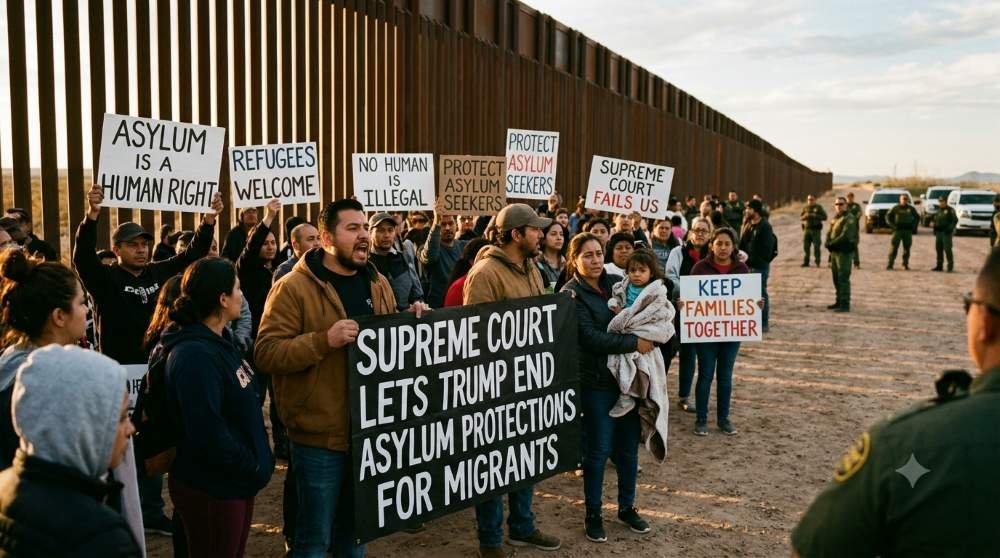
Supreme Court Lets Trump End Asylum Protections for Migrants
The Supreme Court handed the Trump administration two major immigration victories Thursday, opening the door to deport hundreds of thousands of people who have been legally living and working in the United States for years, and making it dramatically harder for new asylum seekers to even apply.
The rulings affect people fleeing some of the most dangerous conditions in the world. Here is what actually happened, and who it impacts.
What the Supreme Court Actually Ruled
The Court issued two separate decisions, both breaking 6-3 along ideological lines.
As per the Associated Press, the Supreme Court on Thursday allowed the Trump administration to end legal protections for migrants fleeing violence and natural disaster in Haiti and Syria, exposing hundreds of thousands more people to potential deportation. The 6-3 decision overturns lower court orders and allows the Department of Homeland Security to swiftly end Temporary Protected Status, a program that currently protects a total of 1.3 million people from 17 countries.
As per PBS News, the Court also voted 6-3 in a separate case to clear the way for the Trump administration to potentially revive an immigration policy once used to turn back migrants seeking asylum at the U.S.-Mexico border. The justices overturned a lower court order that had blocked the practice, which limited the number of people who could apply for asylum each day.
As per the Associated Press, this marked another victory at the high court for President Trump’s sweeping crackdown on immigration. Though the conservative-dominated court has put the brakes on some of Trump’s immigration policies in the past, it handed him two wins on the very same day.
What Is Temporary Protected Status, and Why It Matters
Temporary Protected Status, known as TPS, is a humanitarian program that allows people already in the U.S. to stay and work legally if their home country is considered too dangerous to return to, typically because of war, natural disaster, or political collapse.
As per the Associated Press, the program currently protects 1.3 million people from 17 countries. The ruling specifically clears the way for the administration to end protections for Haitians and Syrians, two of the largest groups covered under the program.
This is not a small technical change. For the people affected, TPS is often the only legal status standing between them and deportation back to countries the U.S. government itself once determined were unsafe to return to.
“A Victory 10 Years in the Making”
The reaction from the White House was immediate and unambiguous.
As per KARK/AP, in a Fox News interview Thursday, Deputy White House Chief of Staff Stephen Miller called the ruling “a victory 10 years in the making,” saying it allows Haitian migrants to “finally” be removed.
Miller did not stop there. As per C-SPAN, in a separate press conference, Miller argued that anyone who no longer has legal status in the country should be deported, and went further to characterize many asylum seekers who travel through multiple countries to reach the U.S. as “criminals, benefit seekers, economic migrants, welfare seekers.”
As per PBS News, Miller summarized the administration’s new posture bluntly: America’s doors are now closed fully to asylum seekers.
“Thousands of Innocent People”, The Legal and Humanitarian Response
Immigration attorneys and advocates are warning the consequences could be deadly.
As per KARK/AP, lawyers said Haitian immigrants would be in real danger if they are sent back to the country. Attorneys Geoff Pipoly and Andy Tauber put it starkly: “Simply put, the Supreme Court’s ruling will directly result in thousands of innocent people dying violent, needless deaths.” They urged the Senate to approve an extension of deportation protections for Haitians, an extension that had already passed the House in April on a rare bipartisan vote.
The human toll is already visible in communities across the country. As per KARK/AP, Viles Dorsainvil, who runs a support center for Haitian immigrants in Springfield, Ohio, described the disruption to ordinary lives: “Families are here, kids are going to school, parents are going into work, folks are trying to commute, and it’s like the Supreme Court just put all those activities on stop and put folks in limbo.”
The Second Ruling: Limiting Who Can Even Apply for Asylum
The Court’s second decision Thursday may end up affecting even more people in the years ahead, by changing the rules for who is allowed to apply for asylum in the first place.
As per the Supreme Court’s opinion in Mullin v. Al Otro Lado, the case centered on a policy that limited the number of people who could apply for asylum at official border crossings each day, effectively creating a long waiting list for asylum seekers. A lower court had blocked the practice; the Supreme Court’s ruling clears the way for the government to revive it.
The Court’s majority reasoned that international treaty obligations against returning refugees to danger do not guarantee migrants the right to enter the country at a time of their choosing, and that asylum law requires a person to be physically present in the United States to be eligible to apply.
Three justices dissented sharply. As per the Supreme Court’s opinion, the dissenting justices argued that Congress has required immigration officers to inspect and process noncitizens seeking asylum at ports of entry since 1980, and that the law lays out mandatory procedures for that process, procedures they argue the administration’s policy circumvents.
As per PBS News, the ruling specifically overturned a lower court order blocking the practice that had been used by presidents of both parties in the past, but which immigrant advocates say creates dangerous backlogs, forcing people fleeing persecution to wait in unsafe conditions at the border for their turn to apply.
What Happens Next
For the 1.3 million people currently protected under TPS, the ruling does not mean immediate deportation, but it does remove the legal shield that has been blocking the administration from ending their status. The Department of Homeland Security can now move forward with terminating protections for Haitians and Syrians, a process that is expected to unfold over the coming weeks and months.
For future asylum seekers, the second ruling means the administration may soon be able to reinstate strict daily limits on asylum applications at the border, a policy that, during its last use, left thousands of people stranded in makeshift shelters in dangerous conditions while they waited for their turn to apply.
Congress retains the power to act. The bipartisan House vote in April to extend protections for Haitian migrants shows the issue is not strictly partisan, but as per the Associated Press, that extension still needs Senate approval, and there is no indication yet of when or whether the Senate will take it up.
What is clear is that this ruling represents one of the most consequential immigration decisions of the year, reshaping who can legally remain in the United States and who can even apply to stay in the first place.