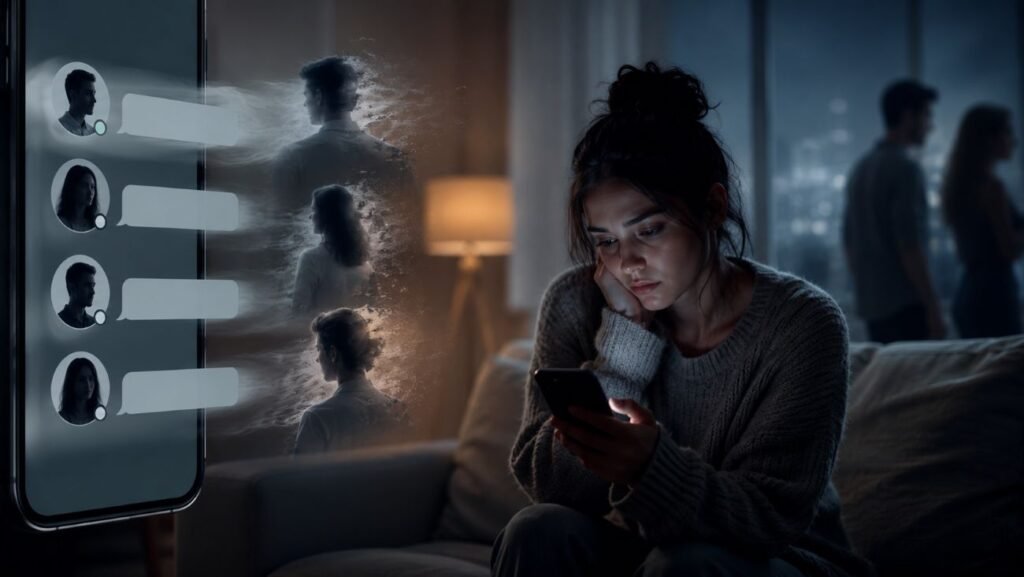
The Rise of “Digital Ghosting” Is Quietly Reshaping Human Relationships in America
Human relationships have always evolved alongside communication technology. Letters transformed emotional distance in earlier centuries. Telephones accelerated personal accessibility. Social media platforms changed how people maintain visibility in each other’s lives. A newer behavioral shift is now emerging across the United States, and its psychological influence is becoming increasingly difficult to ignore.
“Digital ghosting” has evolved from a dating-related phrase into a broader social behavior affecting friendships, workplace communication, family interaction, professional networking, and emotional trust. The pattern involves suddenly withdrawing from digital communication without explanation, often while remaining visibly active online.
The behavior itself is not entirely new. The scale, normalization, and emotional consequences surrounding it have expanded significantly in the smartphone era.
Digital Communication Has Changed the Meaning of Presence
In previous generations, physical absence created emotional distance naturally. Modern communication systems function differently. Most people now carry constant access to messages, notifications, social media feeds, video calls, and instant communication platforms throughout the day.
This permanent connectivity has created a new emotional expectation around responsiveness.
Many individuals now subconsciously associate delayed responses, disappearing conversations, ignored messages, or silent disengagement with emotional rejection. Technology has compressed communication timelines so dramatically that silence itself often carries psychological meaning.
As per source analysis from Pew Research Center, digital communication increasingly shapes how Americans maintain relationships, manage emotional interaction, and interpret social connection. The emotional significance attached to online communication patterns continues to grow across age groups.
The rise of read receipts, typing indicators, online status visibility, and algorithmic interaction tracking has intensified emotional awareness around communication behavior. Many users are no longer reacting only to direct conversation. They are reacting to perceived digital attention patterns.
Emotional Burnout Is Contributing to Ghosting Behavior
The growing normalization of ghosting appears deeply connected to emotional fatigue and digital overload.
Americans are processing unprecedented volumes of daily information, social interaction, workplace messaging, content exposure, and algorithm-driven engagement requests. Smartphones have transformed communication into a near-continuous activity rather than a scheduled social behavior.
Psychologists and behavioral researchers increasingly observe that many individuals are emotionally overwhelmed rather than intentionally cruel when they disengage digitally. Some users report anxiety around replying to messages. Others experience emotional exhaustion from maintaining multiple online social expectations simultaneously.
The result is often avoidance-based communication behavior.
Instead of confronting difficult conversations, explaining emotional boundaries, or managing uncomfortable social interactions directly, many individuals simply disappear from communication channels entirely.
As per source commentary from Harvard Health Publishing, emotional exhaustion and chronic stress can significantly affect communication patterns, social engagement, and interpersonal responsiveness. The pressure of constant digital accessibility may intensify avoidance behavior over time.
Ghosting Is Expanding Beyond Dating Culture
Public discussion around ghosting initially focused heavily on online dating platforms. The behavior has now expanded into broader areas of social life.
Professional ghosting has become increasingly common in hiring environments, freelance communication, networking interactions, and workplace collaboration. Employers sometimes disappear after multiple interview rounds. Job applicants may abruptly stop responding during hiring processes. Business partnerships occasionally dissolve through silence rather than formal communication.
Friendship ghosting is also becoming more visible.
Long-term friendships sometimes weaken through passive digital disengagement rather than direct conflict. Social media creates the illusion of ongoing connection while actual communication gradually disappears. Individuals may continue viewing each other’s online activity while avoiding meaningful interaction entirely.
Family relationships are also experiencing subtle digital distancing patterns. Shortened communication, selective responses, emotionally detached texting habits, and intermittent engagement are becoming increasingly normalized within many households.
Social Media Visibility Has Complicated Emotional Expectations
Modern digital platforms create a psychological contradiction that intensifies ghosting-related distress.
In traditional social separation, emotional closure often occurred through genuine absence. Digital environments rarely provide that separation. A person may stop responding directly while continuing to appear active across social media platforms, content feeds, stories, videos, and online communities.
This creates what behavioral experts increasingly describe as “ambient emotional presence.”
The individual appears socially alive and digitally accessible, yet emotionally unavailable within the specific relationship. That contradiction often creates confusion, anxiety, self-doubt, and emotional rumination for the person experiencing the ghosting behavior.
As per source reporting from American Psychological Association, social media interaction patterns can significantly influence emotional interpretation, social comparison behavior, and relationship-related stress responses.
The emotional challenge is no longer simply absence. The challenge increasingly involves visible disengagement.
Younger Generations Are Adapting to Different Relationship Norms
Younger generations are growing up within communication environments where digital interaction often replaces substantial portions of face-to-face relationship development.
This shift may gradually alter expectations surrounding conflict resolution, emotional accountability, vulnerability, and communication patience.
Many younger users have become highly skilled at initiating digital interaction while simultaneously becoming less comfortable with emotionally difficult conversations. Text-based communication offers emotional distance that direct interpersonal dialogue often does not.
Researchers continue examining whether long-term digital communication habits may influence empathy development, confrontation tolerance, and emotional resilience over time.
The behavioral consequences may extend beyond romance or friendship. Workplace leadership, parenting styles, education systems, and social trust structures could eventually reflect changing communication psychology shaped by digital environments.
Artificial Intelligence Could Intensify the Trend
Artificial intelligence may further complicate human communication behavior in the coming years.
AI companions, emotionally responsive chat systems, and conversational digital assistants are becoming increasingly sophisticated. Some individuals may gradually prefer AI interaction because it removes emotional unpredictability, rejection risk, conflict, and social pressure from communication.
This development introduces a broader societal question.
If emotionally convenient AI systems become easier to interact with than complicated human relationships, social avoidance behavior could accelerate rather than decline.
Technology companies are investing heavily in conversational personalization, emotional response modeling, and AI interaction design. Emotional engagement itself is becoming a competitive technology objective.
As per source reporting from MIT Technology Review, AI developers are increasingly designing systems that simulate natural emotional interaction patterns, creating more immersive and psychologically engaging digital experiences.
The long-term effect may reshape how people define companionship, emotional support, and communication reliability.
The Psychological Cost of Constant Accessibility
One of the deeper contradictions driving ghosting culture involves modern expectations around availability.
People are more digitally reachable than at any point in human history. Emotional accessibility, however, appears increasingly fragmented.
Many individuals now feel pressure to remain continuously responsive while simultaneously struggling with exhaustion, anxiety, information overload, and emotional fatigue. Digital communication has expanded social accessibility without necessarily expanding emotional capacity.
This imbalance may partially explain why ghosting behavior feels increasingly common across modern life.
The issue is not simply technological. The issue involves how technology changes emotional expectations faster than human psychology can comfortably adapt.
Human Relationships Are Entering a Different Digital Era
The rise of digital ghosting reflects more than changing communication habits. The trend reveals a broader transformation in how modern society experiences emotional connection itself.
Technology has created unprecedented communication convenience while simultaneously introducing new forms of emotional ambiguity. Presence no longer guarantees engagement. Visibility no longer guarantees connection. Constant communication tools no longer guarantee emotional closeness.
Human relationships are increasingly being filtered through platforms optimized for speed, efficiency, personalization, and attention retention rather than emotional depth.
The long-term social consequences remain uncertain. Researchers, psychologists, educators, and technology analysts are paying increasing attention to how digital behavior is reshaping emotional trust, conflict management, and interpersonal resilience across the United States.
The next phase of digital society may ultimately depend on whether people learn to balance technological convenience with emotionally sustainable human connection.
IAmericanTimes continues covering world and United States news focused on technology, society, business, behavioral trends, and the evolving human impact of the digital era.