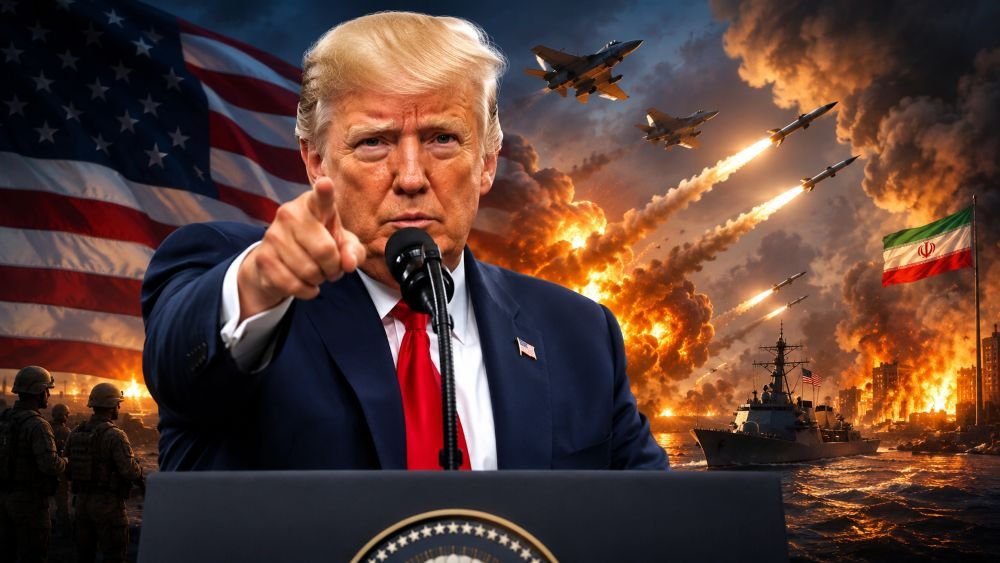
Trump Says Iran Will Be “Defeated Soon” as He Prepares for Biggest Speech of the War
President Trump stood before a room full of Cabinet officials, defense industry leaders, and military brass in Pennsylvania on Wednesday and delivered his most confident assessment yet of the Iran war. “The country is booming,” he said. “And we’ll have Iran defeated soon. They’ll be defeated very soon, and then I guess it’ll be even better.”
Tonight, he will say it to the entire nation.
Trump has announced a primetime address to the United States on Thursday at 9 p.m. EDT, his most significant public statement since the ceasefire collapsed and fighting resumed last week. Here is everything you need to know about where the war stands, what Trump said Wednesday, and what tonight’s speech could mean for every American.
What Trump Said at the Defense Summit
As per Deseret News, Trump spoke Wednesday at the United States Army War College in Carlisle, Pennsylvania, during the Pennsylvania Defense and Innovation Summit. The event was organized by Senator David McCormick and featured some of the most powerful names in the administration: Defense Secretary Pete Hegseth, Joint Chiefs Chairman General Dan Caine, Army Secretary Dan Driscoll, CIA Director John Ratcliffe, and UN Ambassador Mike Waltz.
Trump’s message was one of confidence, even as oil prices have climbed sharply since fighting resumed. As per Deseret News, Trump acknowledged that oil prices have risen in recent days but pushed back hard on fears of a price spiral. “People thought oil would go up to $350 a barrel,” he said. “As of Wednesday, it’s at $79. Days before, it was $68.” He attributed the increase directly to the renewed military action: “It went up a little bit because I had to take tough action because they did not obey what they’re supposed to obey.”
As per Deseret News, when a reporter asked whether he would give Iran a specific deadline to negotiate, Trump declined. “I don’t like giving deadlines,” he said. “They know the story” and “better behave.”
The Primetime Address: What to Expect Tonight
As per The Hill, Trump announced on Truth Social that he will address the nation at 9 p.m. EDT Thursday, describing it as a major statement amid the escalating conflict with Iran.
The speech is being watched closely because this is the moment when Trump must begin making his clearest case to the American public that the war is worth the cost. As per NPR, multiple polls have shown that a majority of Americans disapprove of the war, which has resulted in the deaths of 13 US service members. Trump’s approval rating has hit second-term lows in recent polling averages.
As per PBS News, when Trump addressed the nation in a primetime speech in April, analysts noted that he maintained the war is necessary, nearly won, must continue, and will wrap up soon. Those same four points are expected to anchor tonight’s address as well. What Americans will be watching for is whether Trump offers anything new, including a timeline, a diplomatic pathway, or a clear set of conditions that would end the conflict.
As per Al Jazeera, Iran has warned that if its power plants are struck, it will retaliate against energy and electric infrastructure across the region. That threat hangs directly over tonight’s speech, given that Trump warned Tuesday he would strike bridges and power plants “next week” if Tehran does not return to the table. You can read the full breakdown of Tuesday’s escalation in our earlier report, Trump Threatens to Hit Iran’s Bridges and Power Plants Next Week Unless Tehran Talks.
The War Powers Clock Is Ticking
There is a legal dimension to tonight’s speech that most Americans do not know about, and it is becoming more urgent by the day.
As per PBS News, Trump is fast approaching the 60-day mark under the War Powers Resolution of 1973, at which point he must seek formal approval from Congress to continue military operations against Iran. That deadline transforms tonight’s primetime address from a simple public update into a politically critical moment. Without congressional authorization, the war’s legal foundation becomes increasingly contested.
As per NBC News via MS Now, Trump formally notified Congress on July 10 that “military action” against Iran “commenced on July 7,” satisfying the initial 48-hour notification requirement under the War Powers Act. The letter stated: “United States Armed Forces remain postured to take further action, as necessary and appropriate, to address further threats and attacks upon the United States or its allies and partners.”
But notification is only the first step. As per CBS News, the clock is now running on the 60-day window, and Congress is already dividing sharply over the question of whether to authorize the war, fund it, or try to stop it entirely.
Congress Is Fracturing Over the War
The political battle over the Iran war in Washington reached a new level of intensity this week.
As per CNN, Senate Democrats blocked the annual defense policy package on Tuesday, a must-pass piece of legislation that has passed with bipartisan support for over six decades, citing their objections to the war in Iran. The move was extraordinary and reflects how deeply the conflict has divided the two parties.
At the same time, Republicans are pushing ahead with a separate funding vehicle. As per CNN, the House of Representatives will vote next week on a budget resolution to set the stage for Trump’s third agenda package, which GOP leaders plan to use to pass $87.6 billion in war funding alongside Trump’s desired changes to federal election laws.
As per Fox News, Speaker Mike Johnson confirmed Tuesday that the SAVE and Protect America Act, the combined legislation that ties war funding to election integrity measures, is moving forward. “Given Democrats’ absolute refusal to work with us on the nation’s top priorities, we’re moving forward,” Johnson said.
This is the same legislative standoff that has already held up the bipartisan housing bill Trump refused to sign last month. For the full background on that fight, see our earlier coverage: Congress Passes Housing Bill, Trump Delays Signing It.
Oil at $79: What It Means for Your Wallet
For most Americans, the most immediate impact of the Iran war is not on a battlefield. It is at the gas pump.
As per Deseret News, Trump directly addressed the oil price increase at Wednesday’s summit, framing the rise from $68 to $79 a barrel as a temporary and acceptable cost of military action. That framing will be tested tonight, as Americans who have been paying more at the pump for months are watching closely.
The reality is that oil prices are now 40% higher than they were before the war started in February. Every dollar per barrel increase in oil translates roughly to a two-cent increase in the price of a gallon of gasoline at the pump. A move from $68 to $79 represents a roughly 22-cent-per-gallon increase for American drivers, on top of the increases already accumulated since February.
For the full picture of how the war has been hitting household budgets since it began, read our detailed breakdown: Trump Threatens to Strike Iran’s Secret Nuclear Mountain as War Escalates Again.
The Broader Picture: NATO, Russia, and Hezbollah
The Iran war is also reshaping America’s relationships with its allies in ways that go far beyond the Middle East.
As per NPR, the conflict has further frayed US relations with NATO allies. Trump told Britain’s Telegraph in an interview that he is considering pulling out of NATO because European nations did not join the war in Iran. The administration has since confirmed that NATO Secretary General Mark Rutte will visit the White House next week, in what will be a closely watched diplomatic meeting.
As per Fox News, Trump also signaled this week that Iran and Hezbollah may be added to a bipartisan Russia sanctions bill originally championed by the late Senator Lindsey Graham. “I think they may be adding Iran to it,” Trump said. “They’re going to add Iran, which is a very big thing if they did that. They may add Hezbollah too.”
If that happens, the US would simultaneously be waging a military campaign against Iran, enforcing a naval blockade of its ports, freezing its cryptocurrency assets, and applying the same sweeping financial sanctions originally designed to cripple Russia. It would represent the most comprehensive package of pressure on any single country in modern American history.
For context on how the US troop realignment in Europe fits into this bigger picture, see our earlier report: US Pulling 5,000 Troops From Germany: What It Means for NATO and Every American.
What Tonight’s Speech Needs to Answer
As Trump prepares to address the nation tonight, here are the four questions that Americans most want answered.
First, how many more US service members will die, and what is the plan to bring them home? As per NPR, 13 US service members have already been killed in the conflict.
Second, when does the war actually end? Trump has said “very soon” for months. Tonight, Americans are looking for something more specific.
Third, what is the diplomatic path forward? As per CNN, Iran’s deputy foreign minister declared this week that Tehran has “no obligations” to the 14-point agreement that was supposed to underpin a ceasefire. If that framework is dead, what replaces it?
Fourth, what will this cost American families? Gas is already 40% more expensive than it was in February. Inflation hit 4.2% in May. The administration is asking Congress for $87.6 billion in new war spending. At what point does the economic cost of the war become unsustainable?
Trump will address the nation tonight at 9 p.m. EDT. IAmericanTimes will have full coverage of everything he says and what it means for you.