The New Internet Habits Quietly Changing Human Attention Spans
The internet was once viewed primarily as a tool for information access and communication. Over time, it evolved into a digital environment designed to maximize engagement, shape behavior, personalize content, and compete aggressively for human attention. That transformation is now creating a larger societal conversation about how modern internet habits may be quietly changing human attention spans in ways many people still underestimate.
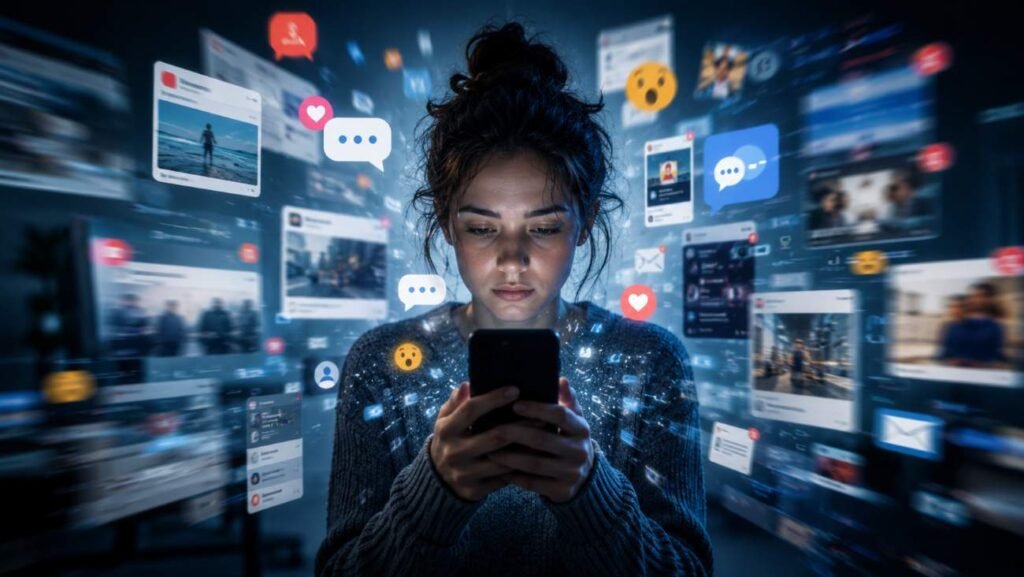
Across the United States, millions of users now consume information through short-form videos, algorithm-driven feeds, endless scrolling systems, AI-curated recommendations, and rapid notification cycles that rarely allow the mind to fully disengage. These habits are becoming deeply integrated into daily life, particularly among younger generations who have grown up inside highly personalized digital ecosystems.
Researchers, educators, behavioral scientists, and technology analysts are increasingly examining whether constant digital stimulation is altering not only how people consume information, but also how they process emotion, memory, focus, patience, and social interaction.
The Attention Economy Has Become One of the Internet’s Most Powerful Industries
Modern internet platforms no longer compete only for users. They compete for sustained psychological engagement.
Social media companies, streaming platforms, advertising systems, gaming applications, and AI-driven recommendation engines all rely heavily on keeping users continuously active inside digital environments. The longer people remain engaged, the more data platforms collect and the more advertising value they generate.
This business model has quietly transformed attention into one of the most valuable economic resources in the digital era.
As per source analysis from Harvard Business Review, modern digital platforms increasingly optimize around behavioral engagement patterns rather than traditional information delivery. Recommendation systems are engineered to maximize interaction frequency, emotional response, and user retention.
That optimization process has created internet habits centered around speed, stimulation, novelty, and constant interruption. Many users now shift rapidly between videos, notifications, messages, advertisements, articles, music, and social content without experiencing extended periods of uninterrupted focus.
The psychological impact of that environment is becoming increasingly visible in schools, workplaces, households, and public discourse.
Short-Form Content Is Reshaping Information Consumption
The rapid expansion of short-form digital content may represent one of the most influential changes in modern online behavior.
Platforms built around extremely brief videos and fast-scrolling feeds have altered how many people consume information. Entertainment, news, education, political commentary, product marketing, and even emotional support are increasingly packaged into compressed digital formats designed for immediate engagement.
This shift has advantages in accessibility and speed. Information can spread rapidly across large audiences, and creators can communicate ideas more efficiently than ever before. The concern emerging among researchers involves whether constant exposure to highly compressed content reduces tolerance for slower, more detailed forms of thinking.
As per source reporting from Pew Research Center, younger Americans increasingly rely on digital platforms and social feeds as primary information environments. News discovery, entertainment, communication, and social validation often occur simultaneously inside the same applications.
The blending of these functions creates an environment where distraction becomes normalized rather than interrupted.
Endless Scrolling Is Changing How People Experience Time and Focus
One of the least discussed internet habits may also be one of the most psychologically influential: infinite content flow.
Many modern platforms are intentionally designed without natural stopping points. Traditional media formats historically contained completion structures such as chapter endings, scheduled programming, or limited publication cycles. Endless scrolling removes those boundaries entirely.
A person can now consume digital stimulation continuously for hours without reaching a meaningful pause point.
Behavioral researchers often describe this environment as cognitively exhausting because the brain remains in a constant state of low-level stimulation and decision-making. Users repeatedly evaluate whether to continue scrolling, click another recommendation, respond to notifications, or switch platforms entirely.
Over time, this constant fragmentation of attention may reduce the brain’s comfort with slower cognitive processes such as deep reading, reflective thinking, extended conversation, or sustained concentration.
As per source commentary from Stanford Human-Centered Artificial Intelligence, researchers continue studying how AI-driven personalization systems influence attention patterns, emotional response, and online behavior.
Emotional Stimulation Is Becoming More Constant
The internet is no longer simply informational. It is increasingly emotional.
Algorithms now prioritize content that generates reactions such as outrage, excitement, anxiety, validation, curiosity, or emotional identification. Emotional engagement drives clicks, comments, shares, watch time, and repeat usage.
This creates a feedback environment where users encounter emotionally stimulating material throughout the day with very few recovery periods.
Many people now begin mornings with notifications, consume emotionally reactive content during work breaks, engage with digital feeds during meals, and continue online activity late into the night. The psychological consequence is not always obvious immediately. Gradual emotional overstimulation may accumulate over time and contribute to feelings of mental fatigue, shortened patience, reduced concentration, and emotional burnout.
Mental health experts are increasingly discussing whether digital overstimulation is affecting stress regulation and emotional resilience, particularly among younger audiences who spend large portions of daily life online.
Artificial Intelligence Is Accelerating Personalized Attention Capture
Artificial intelligence is rapidly intensifying these trends.
Modern recommendation systems now analyze behavioral signals with extraordinary precision. Platforms can evaluate viewing duration, interaction timing, emotional engagement indicators, scrolling behavior, purchase activity, location patterns, and conversation habits in order to personalize digital experiences more effectively.
AI-powered systems are becoming increasingly capable of predicting what content users are most likely to engage with emotionally.
This evolution creates new possibilities for entertainment, education, healthcare communication, and digital accessibility. It also raises growing concerns about whether hyper-personalized digital environments may gradually narrow human attention patterns around constant stimulation and algorithmic familiarity.
As per source reporting from MIT Technology Review, AI-driven recommendation systems are becoming significantly more sophisticated in predicting user behavior and optimizing engagement patterns across digital platforms.
The long-term implications remain uncertain, although researchers increasingly believe the effects could extend far beyond entertainment.
Attention Span Changes Could Influence Society More Broadly
Attention is connected to far more than productivity.
Human attention influences memory formation, learning ability, emotional regulation, social interaction, empathy, political understanding, relationship quality, and long-term decision-making. A society operating inside increasingly fragmented attention environments may experience broader cultural shifts over time.
Educators are already reporting challenges related to sustained student focus and deep reading engagement. Employers frequently discuss rising concerns around distraction and multitasking fatigue. Families often describe difficulty maintaining uninterrupted interpersonal interaction during daily routines.
This does not necessarily mean technology itself is harmful. Digital systems have created enormous educational, economic, and communication opportunities worldwide. The larger issue involves balance and awareness.
The internet is evolving faster than human behavioral adaptation mechanisms typically evolve. Society is still learning how to manage constant digital stimulation while preserving cognitive stability and emotional health.
The Future of Attention May Become One of the Defining Issues of the Digital Era
The modern battle for attention is becoming increasingly invisible precisely because it feels normal.
Most people no longer consciously recognize how often they interrupt tasks, check notifications, switch platforms, scroll emotionally reactive content, or consume fragmented information streams throughout the day. These behaviors have become integrated into ordinary routines.
The next phase of digital culture may involve greater public awareness about how internet architecture shapes human cognition and emotional behavior. Technology companies are already investing heavily in AI-driven personalization systems capable of understanding users with increasing precision. That trend suggests attention competition will likely intensify rather than slow down.
The broader societal challenge may involve learning how to preserve human focus, emotional balance, and meaningful interpersonal interaction inside increasingly engineered digital environments.
IAmericanTimes continues covering world and United States news with a focus on technology, society, business transformation, digital culture, and the emerging trends shaping modern human behavior in the AI era.