Why Countries Around the World Are Quietly Preparing for an AI Workforce Shift
Artificial intelligence is no longer being discussed only as a future innovation project. Governments, corporations, universities, and economic planners across the world are increasingly treating AI as a structural force capable of reshaping labor markets, education systems, national competitiveness, and workforce stability.
Public conversations around artificial intelligence often focus on dramatic predictions involving robots replacing humans overnight. The real transition unfolding globally is far more strategic and far more calculated. Countries are not preparing for a sudden collapse of human employment. They are preparing for a gradual workforce restructuring in which AI systems become integrated into decision-making, productivity operations, customer interaction, logistics, healthcare, manufacturing, finance, education, and digital infrastructure.
This transition is already influencing policy discussions, corporate investment decisions, hiring strategies, and national economic planning in ways that many workers have not fully recognized yet.
Governments Are Increasingly Treating AI as Economic Infrastructure
Many countries now view artificial intelligence not simply as a technology sector, but as critical national infrastructure.
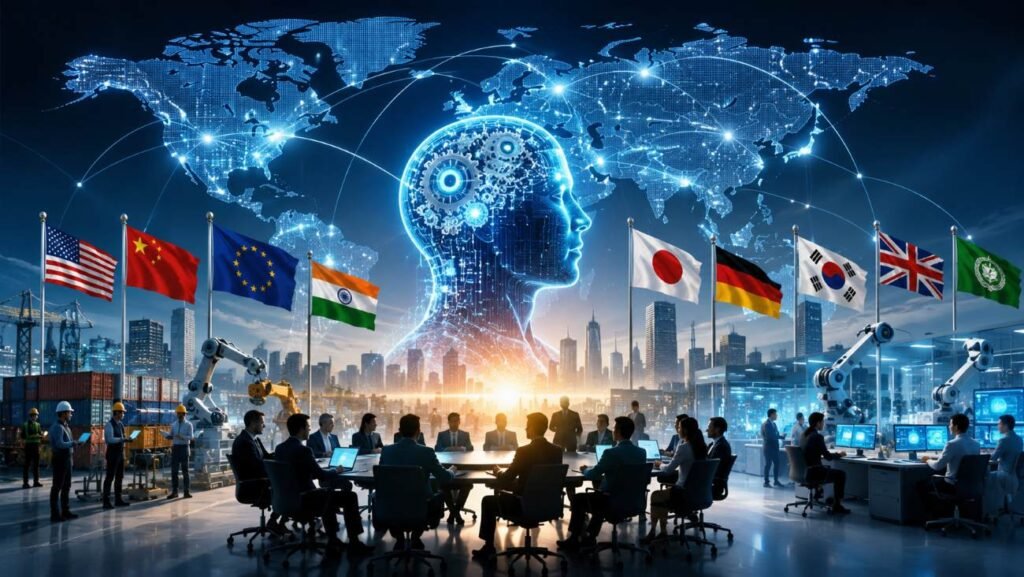
The United States, China, the European Union, South Korea, Japan, the United Kingdom, and several Gulf nations are all accelerating investments into AI research, semiconductor development, automation systems, digital infrastructure, and workforce modernization initiatives.
As per source reporting from World Economic Forum, governments and industries are preparing for large-scale changes in job structures as artificial intelligence becomes integrated into global economic systems. Workforce transformation planning is increasingly tied to national competitiveness strategies.
This shift is happening quietly because governments understand the political and social sensitivity surrounding employment concerns. Public fear around automation can quickly create economic anxiety. Most nations are therefore framing AI investment around productivity growth, innovation, efficiency, and digital modernization rather than openly describing long-term labor displacement possibilities.
The language being used is highly strategic. Officials frequently discuss “upskilling,” “digital readiness,” and “future workforce adaptation” instead of focusing directly on workforce reduction risks.
The AI Workforce Shift Is Likely to Affect White-Collar Jobs First
For years, automation discussions largely centered around factory labor and industrial robotics. The current AI transition is significantly different.
Modern AI systems increasingly affect cognitive and administrative tasks traditionally associated with white-collar employment. Customer support, scheduling, data processing, content generation, coding assistance, legal research, financial analysis, translation, and documentation workflows are already being influenced by AI integration.
This distinction matters because knowledge-based industries employ millions of workers globally.
As per source analysis from McKinsey & Company, generative AI technologies could significantly alter how professionals across sectors perform daily tasks, particularly within administrative, analytical, and communication-heavy roles.
Many companies are not immediately replacing workers outright. The early stage of the shift involves reducing hiring expansion, consolidating responsibilities, and increasing productivity expectations through AI-assisted workflows.
A single employee supported by advanced AI systems may eventually perform work that previously required multiple individuals across certain operational environments. That possibility is quietly reshaping corporate hiring strategies around the world.
Education Systems Are Being Pressured to Adapt Faster
Educational institutions are now facing growing pressure to rethink workforce preparation models.
Traditional educational systems were largely designed around industrial-era labor structures that prioritized repetitive knowledge acquisition, standardized workflows, and predictable professional pathways. Artificial intelligence is disrupting many of those assumptions.
Universities and workforce training programs increasingly recognize that future labor markets may prioritize:
- adaptability
- creative reasoning
- emotional intelligence
- strategic thinking
- interdisciplinary communication
- AI collaboration skills
The concern extends beyond technical education. Countries are beginning to realize that workforce resilience may depend on how quickly populations can adapt psychologically and professionally to rapid technological evolution.
Several governments are now investing in digital literacy initiatives, AI training programs, and workforce transition strategies aimed at preventing large-scale employment instability over the next decade.
As per source reporting from OECD, advanced economies are increasingly examining how artificial intelligence may reshape labor demands, productivity expectations, and long-term workforce development policies.
The Global Competition for AI Leadership Is Intensifying
The AI workforce shift is not occurring in isolation. It is deeply connected to international economic competition.
Countries increasingly understand that AI leadership could influence:
- military strategy
- economic growth
- technological dominance
- industrial productivity
- cybersecurity capability
- global financial influence
This realization has intensified global competition around semiconductors, data infrastructure, AI talent acquisition, cloud computing, and advanced research ecosystems.
China has accelerated large-scale AI investment initiatives. The United States continues expanding private-sector AI development through major technology firms. European regulators are attempting to balance innovation with ethical oversight. Gulf nations are investing heavily in AI diversification strategies to reduce long-term dependence on oil economies.
The workforce implications of this competition are substantial.
Countries that successfully integrate AI into economic systems may experience major productivity advantages. Nations that fail to adapt quickly could face slower growth, labor disruption, and competitive decline within critical industries.
Many Companies Are Quietly Restructuring Before the Public Notices
One of the most important developments in the AI workforce transition is happening inside corporate planning departments rather than public headlines.
Many businesses are currently conducting internal evaluations regarding:
- automation feasibility
- AI integration costs
- workforce efficiency models
- operational restructuring
- long-term staffing needs
Public messaging often emphasizes AI as a supportive productivity tool rather than a workforce reduction mechanism. Internal business calculations can be more complex.
Executives increasingly recognize that AI systems can operate continuously, process large information volumes rapidly, reduce repetitive administrative burdens, and improve scalability across digital operations. Those capabilities naturally influence long-term labor cost considerations.
This does not necessarily mean human workers become obsolete. The likely outcome involves workforce restructuring rather than simple replacement.
Jobs heavily dependent on repetition, predictable analysis, procedural communication, or standardized information processing may experience the highest pressure first.
Roles involving negotiation, human trust, leadership, emotional understanding, crisis management, creativity, and complex interpersonal judgment may remain more resilient during the early phases of AI expansion.
Psychological Workforce Anxiety Is Growing Quietly
One of the least discussed dimensions of the AI workforce shift involves emotional uncertainty among workers themselves.
Many professionals are beginning to question:
- whether their skills remain future-proof
- how quickly industries may change
- whether career paths remain stable
- how AI may affect income security
This uncertainty is influencing workplace culture even before large-scale displacement occurs.
Employees increasingly feel pressure to:
- learn AI tools
- adapt faster
- produce more output
- remain technologically competitive
As per source insights from Harvard Business Review, workplace AI adoption is already reshaping employee expectations, productivity pressures, and organizational dynamics across industries.
The psychological dimension of workforce transition may become one of the defining economic themes of this decade. Rapid technological change often affects emotional stability long before economic statistics fully reflect structural shifts.
The Most Important Workforce Shift May Be Human-AI Collaboration
The future workforce may not be defined by humans competing against AI. It may be defined by humans learning how to operate alongside increasingly intelligent systems.
This distinction is important because the economic winners of the next decade may not necessarily be the most technically advanced individuals alone. The strongest advantage may belong to workers who can integrate human judgment with AI-enhanced productivity effectively.
Human adaptability has historically played a major role during industrial transitions. The rise of computers, the internet, smartphones, and digital commerce all disrupted labor markets while simultaneously creating new economic opportunities.
Artificial intelligence appears positioned to create a similar transformation, although potentially at a much faster pace and across a broader range of industries.
Why This Global Shift Matters More Than Many Realize
The AI workforce transition is not a distant theoretical scenario anymore. It is increasingly becoming part of national planning, corporate restructuring, educational reform, and economic strategy discussions around the world.
Most of the transition is still unfolding quietly beneath public attention. Many organizations understand that openly discussing workforce disruption too aggressively could create unnecessary fear, political backlash, or market instability.
The deeper reality is that countries are preparing for a future in which artificial intelligence becomes integrated into the operational foundation of modern economies.
The central question may no longer be whether AI changes the workforce. The larger question is how societies adapt to a labor environment where intelligence itself becomes partially automated at scale.
That possibility represents one of the most important economic and social transitions of the modern digital era.